
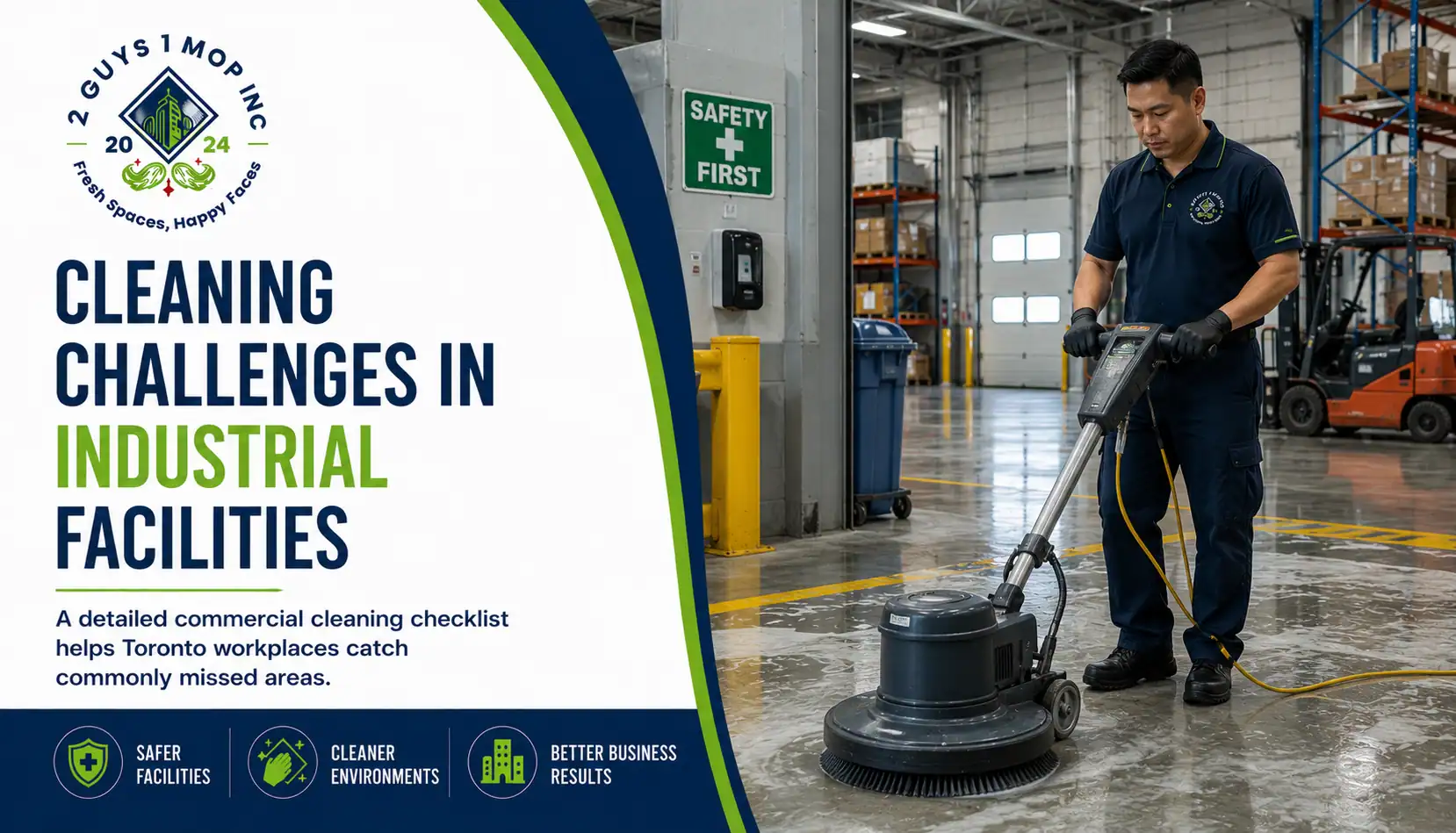
Cleaning Challenges in Industrial Facilities needs an industry-specific lens because different workplaces carry different risks. A medical waiting room, warehouse office, clinic, reception area, or production support space will not need the same cleaning emphasis.
For Toronto businesses, the main challenge is matching the cleaning routine to the environment. A generic checklist may miss high-risk areas, while a tailored plan from commercial cleaning services can separate daily needs from periodic detail work.
For workplace safety context around debris, dust, and housekeeping, managers can also review Ontario construction health and safety guidance when setting practical cleaning expectations.
Cleaning Challenges in This Industry
High-risk areas are usually the ones with repeated contact, shared seating, moisture, debris, food use, or customer traffic. These spaces need clear standards because people notice them quickly.
High-Risk Areas
Daily tasks should protect presentation and basic cleanliness. Periodic tasks should handle buildup, edges, surfaces, equipment zones, and deeper resets that cannot fit into every visit.
- separate office areas from production zones
- schedule debris removal around operating hours
- keep loading doors and mats under control
- watch ledges, racking, and corners for dust
- document areas that need periodic detail work
- review washrooms, lunchrooms, and locker spaces
These tasks should be reviewed with the site layout in mind. The same checklist may need different timing for front entrances, back offices, shared kitchens, waiting areas, boardrooms, or storage spaces.
Daily vs Periodic Cleaning Needs
Staff and customer experience matter too. A space can technically be cleaned and still feel poorly maintained if waiting areas, entrances, washrooms, or shared surfaces are inconsistent.
Clear communication also matters. Managers should know what is handled each visit, what is rotated less often, and how issues are reported. That makes it easier to adjust the scope before a small issue becomes a repeated complaint.
For related support, businesses can compare janitorial services with broader cleaning services to decide which routine fits the building best.
Staff/Customer Experience
Staff/Customer Experience should be reviewed against the building’s actual use, not just against a generic checklist. For Toronto businesses, this means looking at who uses the space, when the busiest periods happen, which surfaces collect residue fastest, and which tasks need to be completed before staff or visitors notice a decline.
Timing should be realistic. Some work belongs after hours, some belongs during a midday check, and some belongs in a monthly detail rotation. The best plan protects the areas people notice most while still handling the details that support long-term appearance.
Businesses can also use the 2 Guys 1 Mop blog to review related cleaning topics and compare how similar facilities handle recurring maintenance needs.
Professional Cleaning Support
Professional Cleaning Support should be reviewed against the building’s actual use, not just against a generic checklist. For Toronto businesses, this means looking at who uses the space, when the busiest periods happen, which surfaces collect residue fastest, and which tasks need to be completed before staff or visitors notice a decline.
The plan should also account for how the space changes during a normal week. A Monday morning walkthrough may show different needs than a Thursday afternoon inspection. Deliveries, meetings, staff schedules, patient flow, weather, and visitor traffic can all shift where cleaning effort should be focused.
For that reason, businesses should connect the written scope with real observations. Notes from supervisors, staff feedback, and periodic inspections can show whether the current routine is controlling buildup or simply reacting after an area starts to look neglected.
It is also useful to separate presentation, hygiene, floor care, and detail work. Presentation tasks keep the workplace looking ready. Hygiene tasks focus on touchpoints and shared areas. Floor care protects surfaces. Detail work catches corners, edges, fixtures, and overlooked spaces before they become obvious.
Different support pages can help a manager compare the right scope for the building, including commercial cleaners in Toronto, Toronto cleaning services, post-construction cleaning in Toronto and 2 Guys 1 Mop blog. Reviewing related services this way helps prevent a one-size-fits-all checklist from being used in spaces with very different needs.
Documentation matters because it turns cleaning expectations into something measurable. Instead of relying on memory or vague complaints, the business can review what was scheduled, what was completed, what changed, and which areas need a different frequency.
Supplies and equipment should be reviewed at the same time. A team needs clean cloths, appropriate products, working vacuums, safe floor tools, stocked consumables, and enough time to complete the agreed scope. Without those basics, even a well-written plan can fall short.
The most effective routines also leave space for seasonal adjustments. Ontario buildings often need more entrance attention in winter, more dust control in spring, closer odour management in summer, and more debris control during wet fall weather. A flexible plan can respond without rebuilding the entire schedule.
When a cleaning plan is reviewed this way, the business can make small improvements before the workplace feels behind. That keeps staff areas, visitor spaces, washrooms, entrances, and shared rooms more consistent throughout the year.
Another useful practice is to compare cleaning needs by zone. A front entrance may need daily attention because it affects first impressions. A storage room may need periodic work because it collects dust slowly. A staff kitchen may need a different rhythm because food, bins, sinks, and appliance handles create separate cleaning pressures.
That zone-by-zone review keeps the plan practical. It prevents lower-risk tasks from taking time away from high-impact areas, while still making sure detail work does not disappear from the schedule. Over time, this produces a cleaner workplace without making every visit feel overloaded.
It also helps to define what success looks like. For some spaces, success means dry entrances and clean traffic paths. For others, it means fresh washrooms, dust-controlled desks, orderly seating, clean glass, or surfaces that feel ready for clients and staff at the start of the day.
Cleaning teams should have a simple way to report recurring issues. If the same mat stays wet, the same counter collects residue, or the same corner gathers dust, that information should change the next version of the schedule. Feedback is most useful when it leads to a specific adjustment.
Businesses should also avoid measuring cleaning only by how the space looks from a distance. Many important tasks are close-up details: fingerprints, edges, appliance handles, chair arms, grout lines, ledges, and areas around bins. These details often shape whether a workplace feels truly cared for.
A reliable routine combines daily presentation with scheduled detail work. Daily tasks protect comfort and first impressions, while detail tasks prevent gradual buildup. Both are needed if the workplace is expected to stay consistent through busy seasons and changing building use.
Managers should revisit the plan whenever occupancy, furniture, tenant use, service hours, or customer flow changes. A schedule that worked last season may need a different balance once a room becomes busier or a new area starts receiving more daily use.
A final review should look at both the customer-facing areas and the working areas behind the scenes. Clean entrances and reception spaces matter, but supply rooms, staff kitchens, equipment corners, and back corridors often show whether the cleaning routine is truly complete.
A strong plan should stay practical. It should name the tasks, assign realistic timing, and give the cleaning team room to respond when weather, traffic, or building use changes. That balance helps Toronto workplaces keep standards consistent without turning every visit into a rushed reset.
When expectations are documented, teams can spot recurring gaps faster. They can also decide when a one-time detail clean, a schedule change, or a broader service review is the right next step.
For next steps, businesses can review contact 2 Guys 1 Mop.
Final Thoughts + CTA
Cleaning Challenges in Industrial Facilities is ultimately about keeping the cleaning plan aligned with the way the workplace is used. The more specific the routine, the easier it is to maintain a clean, comfortable, and professional environment.
If your Toronto workplace needs help with industrial cleaning Toronto, 2 Guys 1 Mop can review your space and recommend a practical cleaning schedule that fits your building.