 Fresh Spaces, Happy Faces
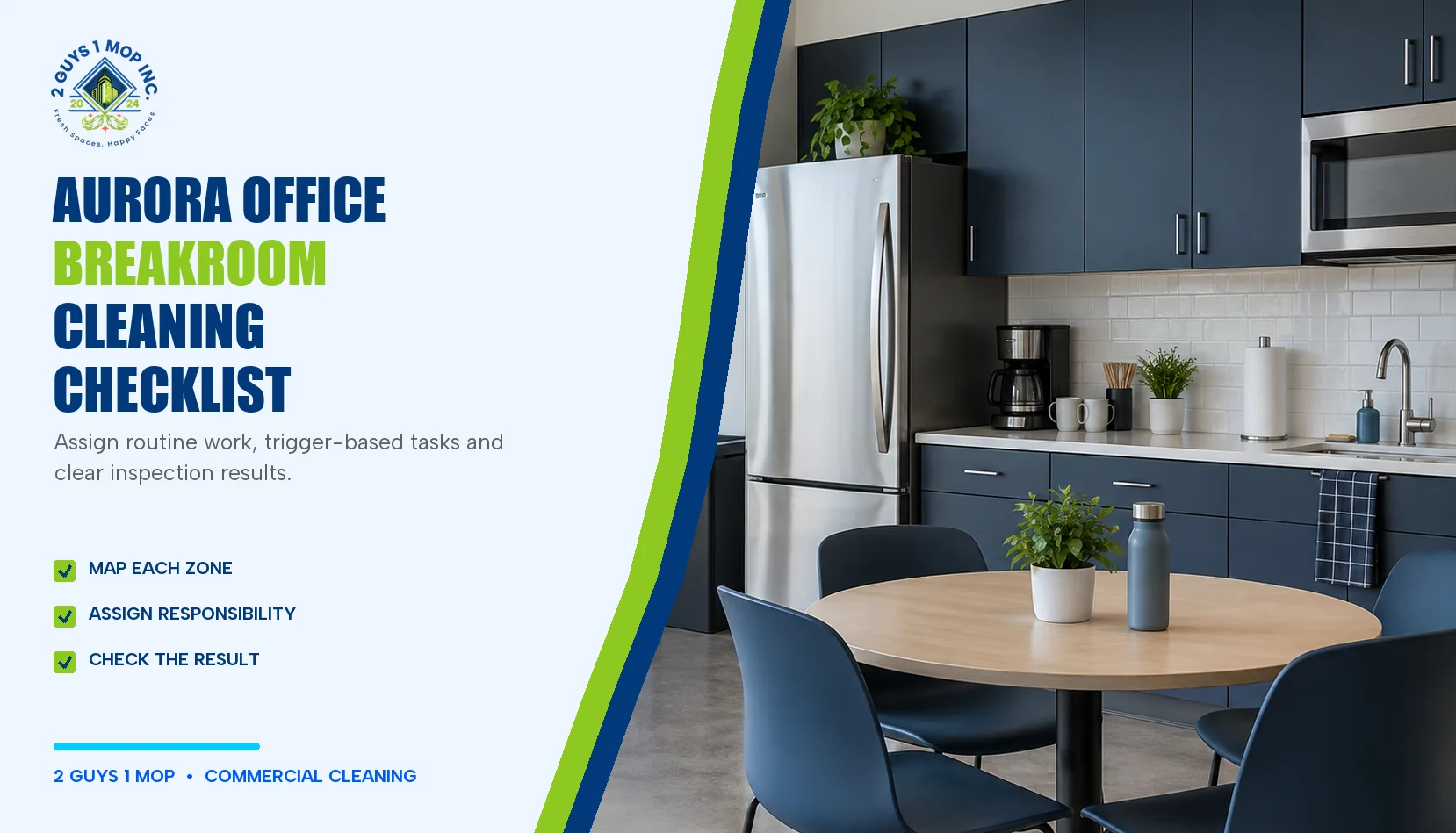
An office breakroom cleaning checklist should do more than repeat “wipe everything daily.” It should identify each zone, assign responsibility, distinguish routine work from spill response, and give the person checking the room a clear result to look for.
This guide is for Aurora office managers, administrators, and facility coordinators building a practical breakroom plan. It is not a universal cleaning frequency or a food-safety plan. The right schedule depends on occupancy, use, workplace procedures, surface instructions, and what inspection shows.
Start with zones, not a generic task list
Breakrooms combine food preparation, shared appliances, water, waste, tables, storage, and foot traffic. A single instruction such as “clean the kitchen” leaves too much room for different interpretations.
Divide the room into zones before assigning tasks:
- Food-preparation surfaces: counters, backsplashes, and other surfaces used while preparing food.
- Shared appliances: refrigerator handles, microwave controls, coffee equipment, kettles, and appliance exteriors.
- Sink and moisture zone: basin, faucet, drain area, splash zone, and nearby dispensers.
- Eating and seating zone: tables, chair contact points, and the floor beneath seating.
- Waste and recycling zone: containers, lids, liners, and the floor around each station.
- Storage zone: cupboards, shelves, and any designated area for shared supplies.
This zone map makes omissions visible and helps separate employee housekeeping from work assigned to a cleaner. For a whole-workplace framework, use the room-by-room office cleaning checklist.
Decide who owns each result
A useful checklist names a role rather than assuming “someone” will notice a problem. CCOHS recommends treating housekeeping as an ongoing program with clear responsibilities for cleanup, waste, storage, and inspection.
Employees and breakroom users
Workplace rules may assign users immediate tasks such as:
- placing waste and recycling in the correct containers;
- removing personal food by the office’s stated deadline;
- reporting a leak, spill, broken appliance, or damaged surface;
- returning shared items to their designated place; and
- leaving food-preparation space clear enough for the scheduled cleaner to reach it.
The scheduled cleaning provider
The written service scope should state which surfaces are cleaned, the expected result, the frequency or trigger, and important exclusions. “Clean microwave” can mean the exterior only, while another scope may include the interior when it is empty and safe to access. The contract should remove that ambiguity.
The office manager or designated checker
The checker confirms that the result is acceptable, records recurring exceptions, and escalates building or equipment problems. Cleaning does not repair a leaking pipe, damaged seal, faulty refrigerator, pest issue, or unsafe electrical condition.
Daily or high-use checks
Use these checks on operating days or at another frequency supported by actual use:
- Counters are clear enough to clean and have no visible residue.
- Tables and chair contact points have no visible food, spills, or debris.
- Sink and faucet areas have no standing residue or overflowing waste.
- Appliance handles and controls included in scope have been addressed.
- Waste and recycling containers are not overflowing and liners are secure.
- Floors have no loose debris, wet spots, or tracked residue in traffic paths.
- Exits and access routes remain clear.
- Supplies assigned to the area are stocked to the agreed level.
- Leaks, damaged surfaces, unusual odours, or appliance concerns are reported rather than concealed.
The result matters more than mechanically checking a box. If a lunch meeting creates unusual use, the room may need an extra reset even when the normal schedule was already completed.
Weekly detail checks
Weekly work can address details that routine resets may not reach. Adjust the interval to the room’s use and inspection results.
- Check cabinet fronts, shelf edges, baseboards, and corners for residue.
- Clean reachable appliance sides and the floor edges around movable items when safe.
- Review the refrigerator clean-out process and remove only items covered by the workplace policy.
- Check waste-container exteriors and the floor beneath or behind each station.
- Inspect the sink splash area, dispensers, and nearby wall surfaces.
- Look for recurring crumbs, spills, or clutter that indicate the daily responsibility split is unclear.
- Confirm that cleaning products are stored, labelled, and used according to workplace procedures and product instructions.
Trigger-based tasks belong on the checklist
Some work should happen when a condition appears rather than on a fixed day.
| Trigger | Immediate response | Follow-up |
|---|---|---|
| Food or drink spill | Restrict the area if needed and follow the workplace spill procedure | Check for residue, floor condition, and any damaged surface |
| Overflowing waste | Replace the liner and address visible residue around the station | Review container size or collection frequency if it repeats |
| Refrigerator leak or standing water | Protect the area and report the equipment or building issue | Clean only within the authorized scope after the source is controlled |
| Broken glass or sharp object | Keep people away and use the workplace’s safe-handling procedure | Record the incident and inspect for remaining fragments |
| Persistent odour | Identify likely waste, drain, food, or equipment sources without masking the condition | Escalate unresolved causes to the appropriate manager or technician |
| Damaged counter, floor, or seal | Mark or isolate the affected area when necessary | Arrange repair; cleaning is not a substitute for maintenance |
CCOHS advises cleaning spills promptly using appropriate procedures and personal protective equipment. A site-specific procedure should take priority over an improvised response.
Clean, sanitize, or disinfect?
These words do not mean the same task. Cleaning removes visible soil and residue. Sanitizing or disinfecting uses a suitable product for a defined purpose and requires the label’s directions, including surface compatibility, dilution, contact time, and any rinse instructions.
For a fuller decision framework, see office breakroom cleaning: clean, sanitize, or disinfect. Do not treat a disinfectant as a substitute for removing soil first, and do not mix products unless the labels explicitly permit it.
The Public Health Agency of Canada recommends including shared kitchens and high-touch surfaces in workplace cleaning protocols and adjusting attention according to use. That guidance supports a documented process; it does not establish one universal schedule for every Aurora office.
Refrigerator and appliance rules need written boundaries
Shared appliances create disputes when no one knows what the cleaner is allowed to move, discard, or unplug. Record the answers to these questions:
- Who removes expired or unlabelled food, and on what notice?
- May a cleaner move personal containers or food?
- Is the refrigerator interior part of recurring work or a separately scheduled reset?
- Who confirms that an appliance can be unplugged or moved?
- Which appliance interiors are excluded unless empty and cool?
- Who reports damaged cords, leaks, loose handles, or unusual heat?
The checklist should never direct a cleaner to service or dismantle equipment. Manufacturer instructions and workplace safety procedures control what can be moved or cleaned.
Use an inspection result, not a vague standard
“Looks good” is difficult to apply consistently. A short inspection should use observable results:
- no visible food or drink residue on included surfaces;
- no loose debris in accessible floor areas;
- no overflowing waste;
- no standing liquid left in traffic paths;
- supplies restored to the agreed level;
- excluded clutter or personal items recorded when they prevented access; and
- maintenance or safety concerns reported to the named contact.
Photographs may help document an exception, but only when the workplace permits them and no personal or confidential information is captured.
Turn the checklist into a service scope
Before requesting service, note the number of employees using the room, busiest meal periods, appliances, floor material, waste setup, access window, and any building rules. Then convert the checklist into areas, tasks, frequencies, triggers, exclusions, and inspection results.
Aurora businesses comparing recurring support can review commercial cleaning services in Aurora or request a site-specific walkthrough. A walkthrough allows the final scope to reflect the actual room instead of a generic template.