 Fresh Spaces, Happy Faces
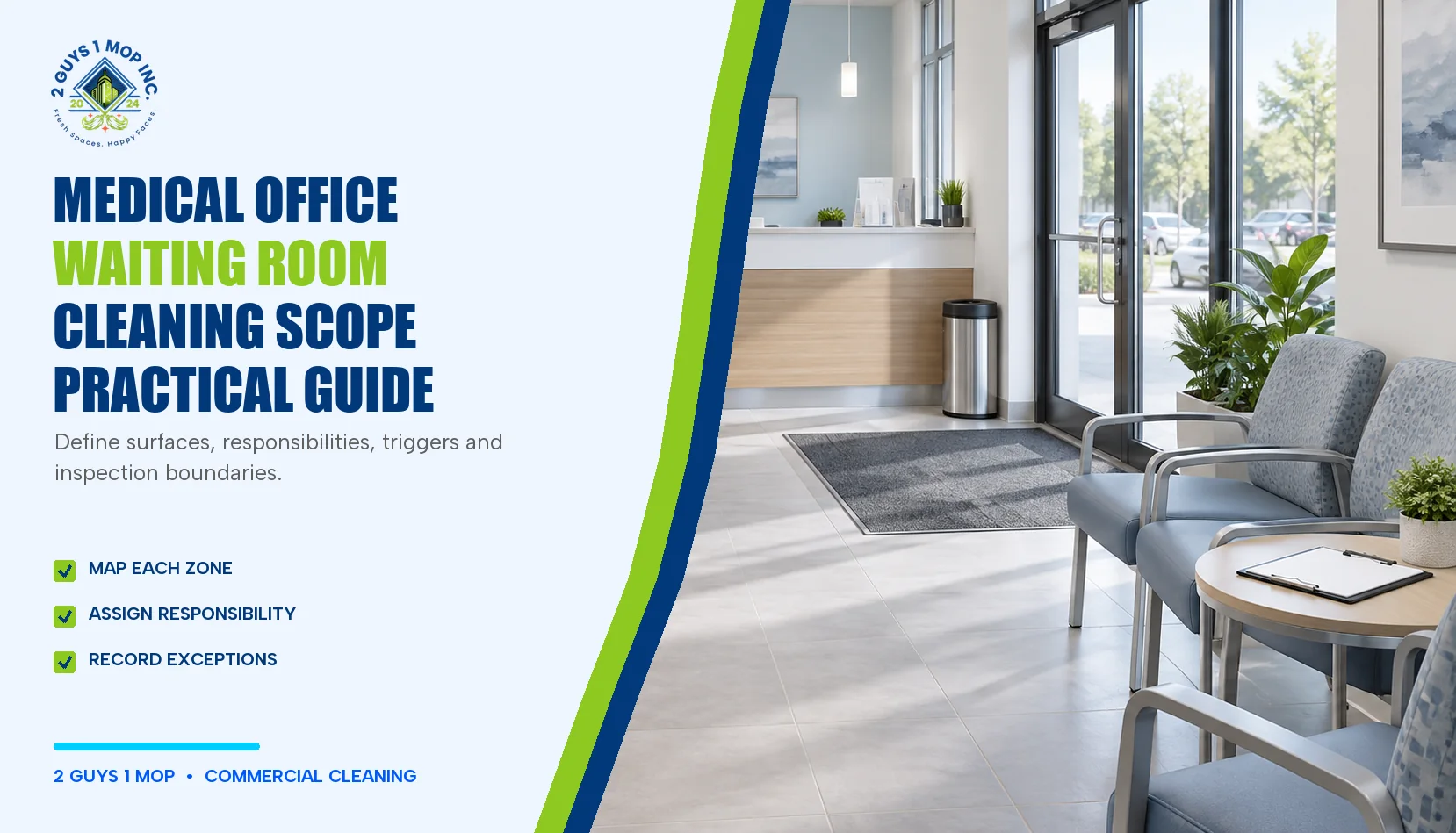
A medical waiting room needs more than a list of surfaces. It needs a written scope that tells clinic staff and the cleaning provider what is routine, what changes with patient traffic, and what must be escalated under the clinic’s own infection-prevention procedures.
This guide covers non-clinical waiting areas: entrances, reception-facing surfaces, seating, floors, waste, and nearby public washrooms. It does not replace a clinic’s infection-prevention policy, product instructions, occupational-health requirements, or clinical response procedures.
Start with responsibility, not frequency
“Clean every day” is not a complete standard. A usable scope identifies the task, the responsible party, the condition that triggers the work, the approved method, and how completion is checked.
For each zone, record five things:
- what receives routine cleaning;
- what receives disinfection when the clinic’s policy calls for it;
- who handles mid-day issues while the clinic is occupied;
- what is outside the cleaner’s ordinary scope; and
- who receives an escalation note.
This prevents a common gap: clinic staff assume the evening cleaner handles an issue that arose during the day, while the cleaner assumes staff already addressed it.
Separate routine cleaning from clinical escalation
Routine waiting-room work can include visible-soil removal, chair and table cleaning, reception-facing touchpoints, floor care, waste removal, entrance maintenance, and public-washroom tasks included in the contract.
Clinical waste, sharps, blood or body-fluid incidents, isolation precautions, and treatment-room protocols require instructions from the clinic. They should not be silently added to a general office-cleaning checklist. The written scope needs a clear stop-and-report rule for anything outside the approved non-clinical service.
Public Health Ontario’s environmental-cleaning guidance emphasizes organized programs, defined responsibilities, training, product selection, and monitoring. The practical lesson for a waiting room is straightforward: the room’s cleaning plan must connect to the clinic’s broader policy rather than operate as an informal side list.
Build the scope by waiting-room zone
Different parts of the room need different checks.
| Zone | Routine review | Scope question |
|---|---|---|
| Entrance | Mats, tracked soil, moisture, glass and door hardware | Who responds when weather changes conditions during operating hours? |
| Reception-facing area | Counter surfaces, payment or check-in equipment boundaries, ledges | Which equipment may the cleaner touch, and which belongs to clinic staff? |
| Seating | Chair arms, frames, visible soil, spaces below and between seats | Are the materials compatible with the approved products and method? |
| Shared surfaces | Side tables, dispensers, brochure holders and children’s-area items if present | Which items are cleaned by staff, removed, or included in the contracted route? |
| Floors | Open areas, edges, under-seat zones and spot response | Does the method match the actual floor material and occupancy schedule? |
| Waste | Bin exterior, liner replacement and surrounding floor | What waste is ordinary, and what must be escalated? |
| Public washroom | Fixtures, supplies, touchpoints, floor and inspection | Is the washroom included in the same visit and check record? |
The scope should name exclusions as clearly as inclusions. Vague wording such as “sanitize all surfaces” creates uncertainty about equipment, upholstery, toys, clinical materials, and areas occupied during service.
Let conditions determine frequency
There is no single schedule that fits every waiting room. Frequency depends on patient traffic, hours of operation, weather, floor and furniture materials, visible soil, waste volume, the clinic’s policy, and the directions for the products being used.
Use three frequency layers:
- Scheduled routine: tasks completed on every contracted visit.
- Condition-based response: extra attention when a surface is visibly soiled, a bin is full, moisture reaches the entrance, or traffic changes the room.
- Rotational detail: edges, chair bases, vents, high ledges, and other slower-buildup areas assigned to a documented cycle.
If a problem repeatedly appears before the next visit, the answer may be a mid-day staff responsibility, a revised service time, a route change, or additional contracted work. Repeating the same instruction without changing ownership or timing does not solve the gap.
Match the method to the surface and product label
Cleaning removes soil and debris. Disinfection is a separate step used when the clinic’s policy calls for it. The product must be suitable for the surface and used according to its label, including any required contact time. The Public Health Agency of Canada’s cleaning and disinfecting guidance reinforces the need to follow product labels and distinguish cleaning from disinfection.
Avoid assuming that one product or one cloth belongs on every surface. Upholstery, finished wood, plastics, electronics, glass, and resilient flooring can have different compatibility limits. The clinic should also identify equipment that cleaning staff must not handle.
The Canadian Centre for Occupational Health and Safety guidance for cleaning staff covers product safety and safe work practices. A contract should support those controls with approved products, accessible instructions, and a clear way to report damaged containers, missing labels, or an unexpected task.
Make the handoff visible
A short service record is more useful than a long checklist nobody reviews. It can document:
- service date and time;
- scheduled areas completed;
- condition-based work added;
- supplies or access problems;
- damage or recurring soil observed;
- tasks deferred because the space was occupied; and
- incidents referred to clinic staff.
The clinic’s reviewer can then look for patterns. A damp entrance at the same time each day, a full waste bin before the evening visit, or recurring soil under one seating bank points to a scope or timing decision—not simply a request to “clean better.”
Use a five-minute inspection
After a service visit, check one item from each major zone:
- the entrance and first traffic path;
- a reception-facing surface;
- one representative chair or seating bank;
- the waste area;
- the floor edge or under-seat zone; and
- the public washroom, when it is in scope.
Record only exceptions. If the same exception appears twice, review the instruction. If the instruction is clear but the task still fails, review time, access, product suitability, training, or supervision.
Information to prepare before requesting a quote
Before asking a commercial cleaning service to price the work, prepare:
- operating and preferred service hours;
- approximate waiting-room traffic patterns;
- floor, seating, and counter materials;
- public-washroom inclusion or exclusion;
- staff responsibilities during open hours;
- clinic-approved products or restrictions;
- equipment the cleaner must not touch;
- waste and incident escalation rules; and
- the person who reviews service notes.
Businesses comparing office cleaning in Aurora can use the same information to distinguish a defined waiting-room route from a generic office checklist. For a related boundary discussion, review the site’s guide to medical-office disinfection planning.
The practical standard
A useful medical waiting-room cleaning standard makes routine work observable and keeps clinical decisions with the clinic. It identifies surfaces, responsibilities, triggers, methods, exclusions, and escalation points without pretending that every waiting room needs the same schedule.
If you want help translating the room’s actual use into a reviewable non-clinical cleaning scope, request a site review.