 Fresh Spaces, Happy Faces
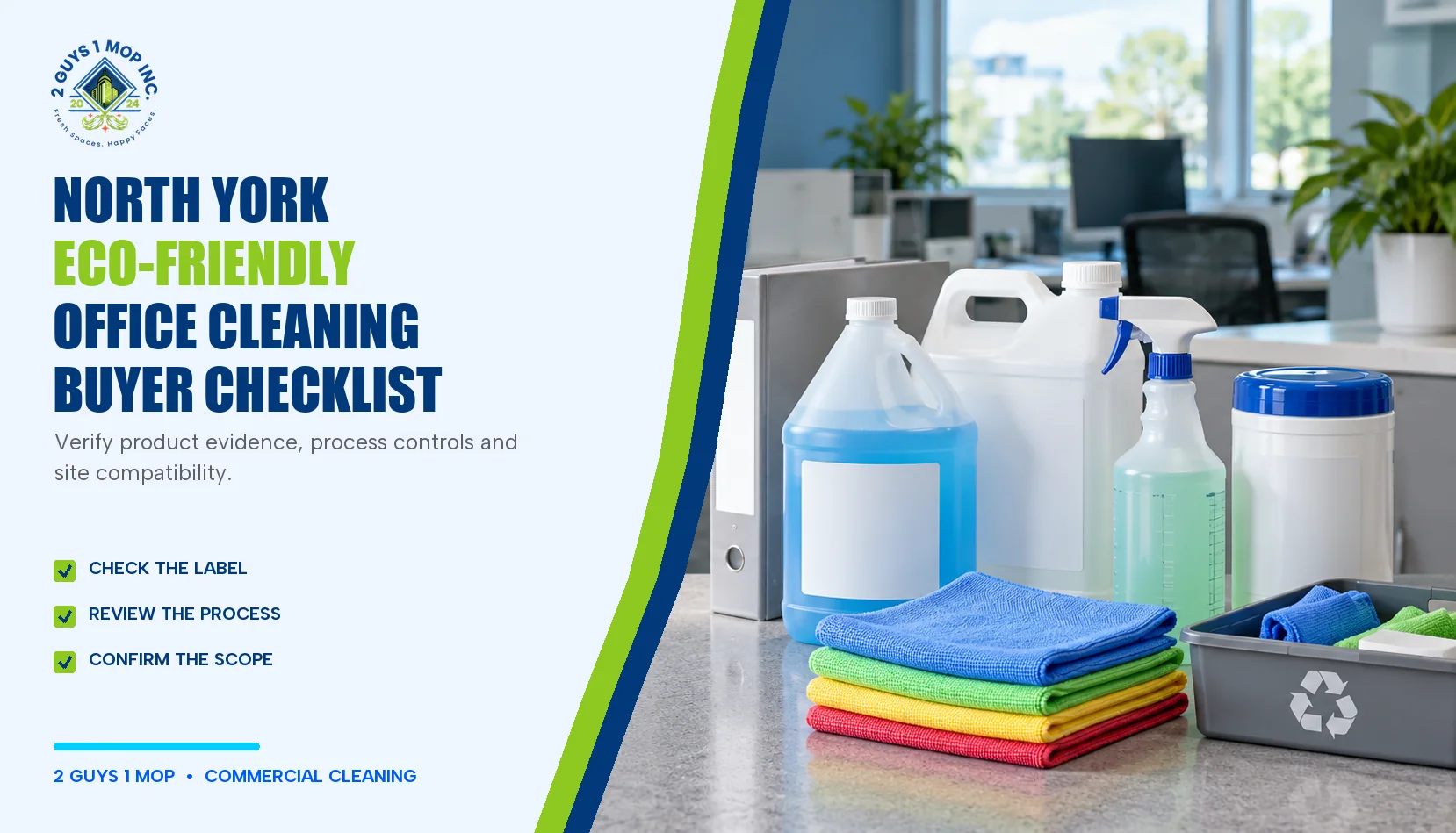
Eco-friendly office cleaning in North York should be evaluated as a set of verifiable product and process choices—not as a blanket promise. A useful buyer review checks what is used, how it is diluted and applied, whether the claim has evidence, how waste is handled and whether the approach is suitable for the building’s surfaces and actual cleaning needs.
Define the building’s goal first
“Greener” can refer to different goals: reducing unnecessary product use, choosing credible environmental criteria, limiting packaging, avoiding avoidable waste, or selecting a process that fits indoor-air and occupant needs. List the priority and the sensitive areas before comparing proposals. A fragrance-sensitive workspace, a childcare setting and a food-contact breakroom do not present the same decision.
- Rooms, surfaces and tasks covered by the request
- Known sensitivities or building policies
- Cleaning, sanitizing or disinfecting outcome required
- Surface warranties and manufacturer instructions
- Packaging, concentrate, water and waste preferences
- Evidence the buyer expects for environmental claims
Ask for product and claim evidence
Request a current product list, label directions and safety data sheets (SDS) where applicable. If a supplier cites an environmental certification, ask for the exact product and current certification—not a general logo or an unsupported statement about the whole program. A purchasing claim should be specific enough to verify.
Government of Canada green-procurement guidance describes environmental performance across a product or service’s life cycle and points buyers toward applicable third-party certifications or environmental product declarations. Those ideas can inform a cleaning proposal, but they do not prove that any particular product is suitable for every task.
Separate cleaning from antimicrobial claims
A cleaner removes soil from a surface. Sanitizers and disinfectants make regulated antimicrobial claims and have labelled conditions of use. Health Canada’s current biocide guidance distinguishes cleaners from products represented to control micro-organisms on non-living surfaces. That distinction matters: a general “eco” description is not evidence that a product disinfects, and routine disinfection should not be added to every surface without a defined need.
Where sanitizing or disinfecting is required, confirm that the product is authorized for the intended Canadian use and that label directions—including surface, dilution, application and contact time—can be followed. Cleaning performance, safety and surface compatibility remain part of the decision.
Review the process, not only the bottle
A concentrated product can still be wasted if it is mixed inaccurately. A reusable cloth system can transfer soil if cloths are not changed or separated appropriately. Ask how the proposal controls dilution, applicators, cloths, mop heads, water, packaging, equipment and waste. Then connect each control to a specific task in the office cleaning checklist.
| Buyer question | Useful evidence | What it does not prove |
|---|---|---|
| What products are proposed? | Current product list and label | Suitability for every surface |
| How is each environmental claim supported? | Exact current certification or documented criterion | That the entire service is “green” |
| How is dilution controlled? | Label-based procedure or controlled system | Correct use unless the process is followed |
| How are cloths and mops managed? | Task or zone separation and change procedure | That one colour system fits every building |
| How is packaging reduced? | Concentrate, refill or return details where actually used | Lower total impact without broader context |
| How are exceptions handled? | Written escalation and substitution approval | Permission to improvise with another product |
Protect surfaces and required performance
A lower-impact preference does not override a floor, textile, stone, electronic or fixture manufacturer’s instructions. Confirm pH, moisture, residue, dwell time and application limits where relevant. Test an unfamiliar method in an inconspicuous area when the manufacturer or procedure calls for it.
Health Canada’s final office-building indoor-air guidance addresses building stewardship and source control. It does not establish that one cleaning product will improve a particular office’s air quality. Ventilation or building-system concerns belong with the appropriate building professional.
Use a claim-evidence-boundary check
| Claim | Evidence to request | Boundary |
|---|---|---|
| Certified product | Exact product listing and current certification | Certification applies only within its stated scope |
| Reduced packaging | Packaging format and actual delivery practice | Do not infer total life-cycle impact |
| Low-odour option | Exact product and site trial if appropriate | Low odour is not the same as harmless or suitable |
| Disinfecting product | Canadian authorization and label directions | Use only for the labelled purpose and conditions |
| Water-saving process | Method and task comparison | Must still meet surface and cleaning requirements |
Build the requirements into the scope
Put approved products, prohibited substitutions, task methods, documentation and exception steps into the service scope. The commercial cleaning contract checklist explains how to define responsibilities and change terms. Compare the requirements with the actual North York office cleaning or commercial cleaning scope rather than relying on a marketing label.
If an unknown spill, regulated material, specialist surface or infection-control requirement falls outside the ordinary plan, stop and identify the correct specialist or procedure. To review a site-specific request without assuming unverified product practices, request a walkthrough and bring the building’s product policies and surface requirements.
Sources and status
- Health Canada: Guidance on biocides — current regulatory guidance.
- Health Canada: Office-building indoor-air guidance — final guidance published September 2025; not a product-performance guarantee.
- Public Services and Procurement Canada: Applying the Policy on Green Procurement — procurement guidance, not product certification or a private-sector requirement.