 Fresh Spaces, Happy Faces
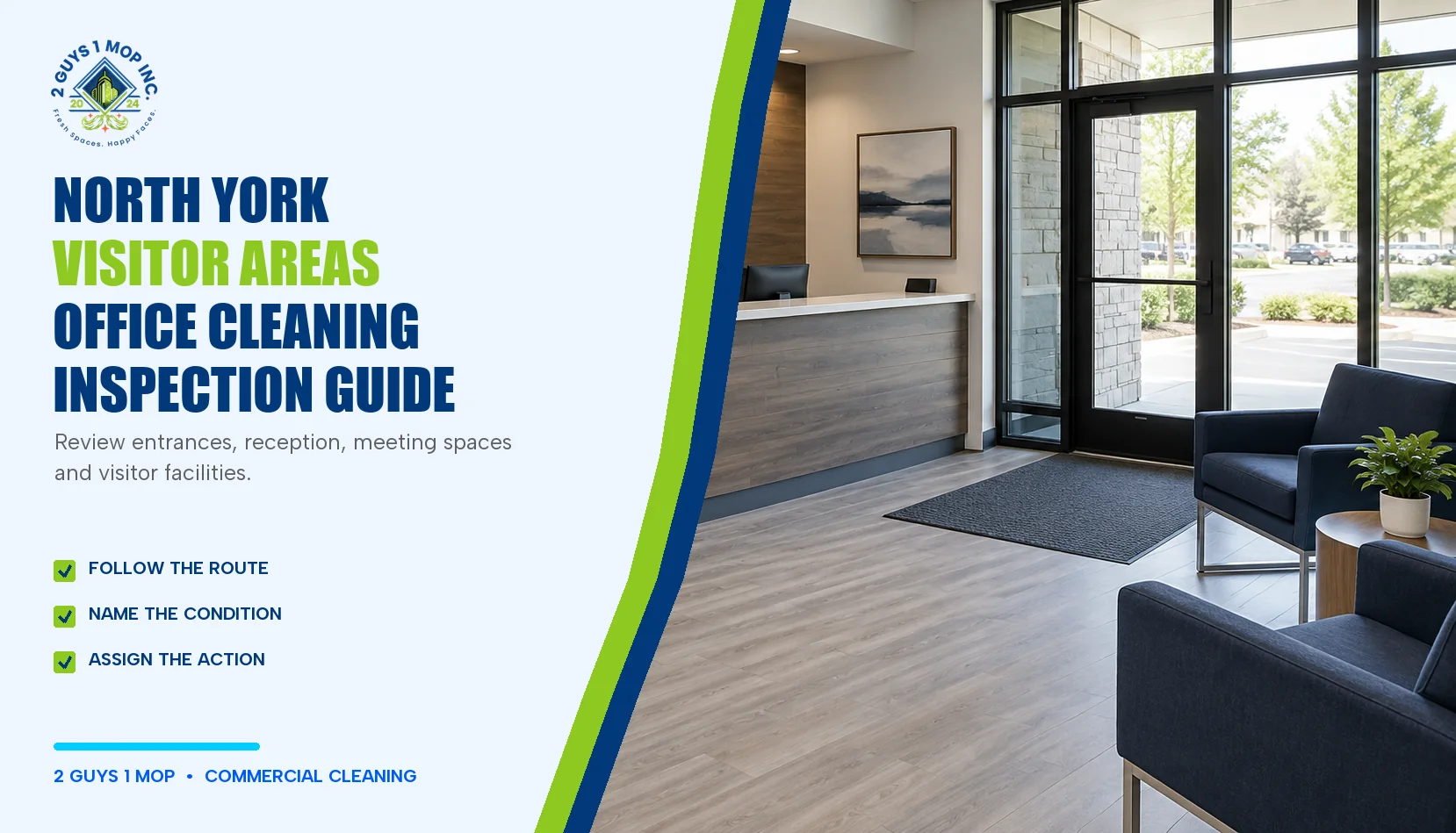
Customer-facing office cleaning is easier to review when you follow the route a visitor takes: entrance, reception, seating, meeting room and public washroom. For a North York business, a useful standard describes visible conditions in those spaces and assigns the work needed to keep them ready.
Cleaning does not guarantee customer trust, a stronger reputation or more sales. This guide gives you a practical inspection route for the parts of the office visitors use, with clear boundaries between cleaning, staff resets and maintenance.
Map the actual visitor route
Walk from the public entrance to the place where visitors wait or meet. Include the washroom they can use and any shared corridor that belongs to the property’s cleaning scope. Some areas may be managed by the building rather than your office; confirm ownership before adding tasks.
Choose representative surfaces along the route. A door pull, counter edge, waiting chair, meeting table and floor transition can make the check repeatable. This is an editorial inspection method, not a certification or claim that a short walkthrough proves the whole building is clean.
For a more detailed room checklist, see reception-area cleaning in North York. This article focuses on how to define, inspect and hand off the complete visitor route.
Describe the condition you want to see
Use observable criteria instead of “brand standards” alone. Identify the surface and the condition that would require action. Where a finish has existing wear, record it so damage is not repeatedly mistaken for removable soil.
| Visitor stop | Observable review | Separate issue to refer |
|---|---|---|
| Entrance | Visible soil, glass marks, mat condition and moisture | Loose mat, damaged flooring or door fault |
| Reception | Counter residue, ledge dust and ordinary waste | Documents, equipment faults or private materials |
| Waiting seats | Visible marks, debris around bases and accessible surfaces | Torn upholstery or unstable furniture |
| Meeting room | Table residue, ordinary waste and agreed chair arrangement | Staff papers, technology or booking conflicts |
| Public washroom | Included fixtures, visible soil, supplies and floor condition | Plumbing fault, leak or damaged fitting |
The CCOHS general housekeeping inspection checklist provides related questions about floors, access, waste and facility condition. Use it as background for your property-specific review, rather than treating it as proof of a customer’s reaction.
Check in normal use, not only after a visit
Agree on an inspection time that reflects visitor activity. An opening check can confirm the overnight result; another check before an important meeting can show what changed during occupied hours. The timing is a planning choice based on use, not a universal twice-daily cleaning requirement.
If the entrance becomes wet after arrivals, check the mat and the assigned daytime response. If a meeting room has cups after a booking, check the room-reset responsibility. Record the condition and its timing before deciding whether to change the cleaning contract.
The CCOHS basic housekeeping guide emphasizes ongoing responsibilities and inspection. A visitor-area plan should likewise name who responds between scheduled visits.
Match the method to the material
Glass, finished wood, laminate, metal, upholstery and flooring can have different care requirements. Confirm the product and method against the surface manufacturer’s instructions. Avoid using the same treatment everywhere simply because the surfaces sit along one route.
For cleaning and any required disinfection, follow the product label and the property’s policy. Keep electrical equipment and confidential materials within explicit handling boundaries. The CCOHS guidance for cleaning staff is a relevant starting point for product and work-practice controls.
A persistent stain, worn finish or damaged seat may need specialist assessment or repair. Record the issue and refer it to the appropriate owner instead of asking for repeated aggressive cleaning.
Give each exception a next action
A short exception log can identify the stop, observed condition, time, owner and follow-up. For example: “Entrance mat damp at opening; office coordinator to review daytime mat response.” This describes something the team can act on without speculating about lost sales or visitor confidence.
Use three practical actions:
- Reset an ordinary condition within the assigned scope.
- Report an access, supply or responsibility gap to the manager.
- Refer damage, a leak or another maintenance concern to the building or facilities contact.
For urgent hazards, follow the property’s established safety procedure. Do not postpone reporting while completing a presentation inspection. Do not photograph visitors, confidential papers, screens or private access details for a general cleaning log.
Test recurring presentation problems
Consider an illustrative reception counter that shows residue shortly before afternoon appointments. Check whether the mark appeared after cleaning, whether staff use the surface during the day and whether a daytime wipe is assigned. Changing the evening method is useful only if it addresses the observed cause.
In a second illustrative case, the meeting room looks untidy because staff leave papers and equipment on the table. Agree on preparation and handling limits before adding the table to the route. A cleaner cannot safely guess which documents may be moved.
Review one recurring issue at a time. Change the relevant instruction, timing or owner and inspect again during comparable use. The result is evidence about that surface or room, not a measure of brand reputation.
Connect the route to the wider cleaning scope
Visitor areas need to fit into the complete office plan. A strong reception result does not establish the condition of kitchens, private workstations or back-of-house spaces. Use an office cleaning checklist to organize the wider scope, and reserve this route for the visitor-facing review.
When comparing commercial cleaning services, bring the route, materials, access windows, known damage, daytime tasks and acceptance criteria. Confirm what the provider includes and what the office or building team retains.
If access depends on occupied hours, review the after-hours office cleaning checklist as a separate operational step. The inspection criteria should remain the same regardless of which authorized service window is chosen.
Set a standard the team can review
Choose five visitor stops, describe the acceptable visible conditions, assign daytime and scheduled tasks, and log recurring exceptions. That turns a broad request to “protect the brand” into a review the team can repeat.
Keep business outcomes separate from the cleaning record. If the route reveals a service gap, request a walkthrough with the room list and observed issues so the proposed scope can address them directly.