 Fresh Spaces, Happy Faces
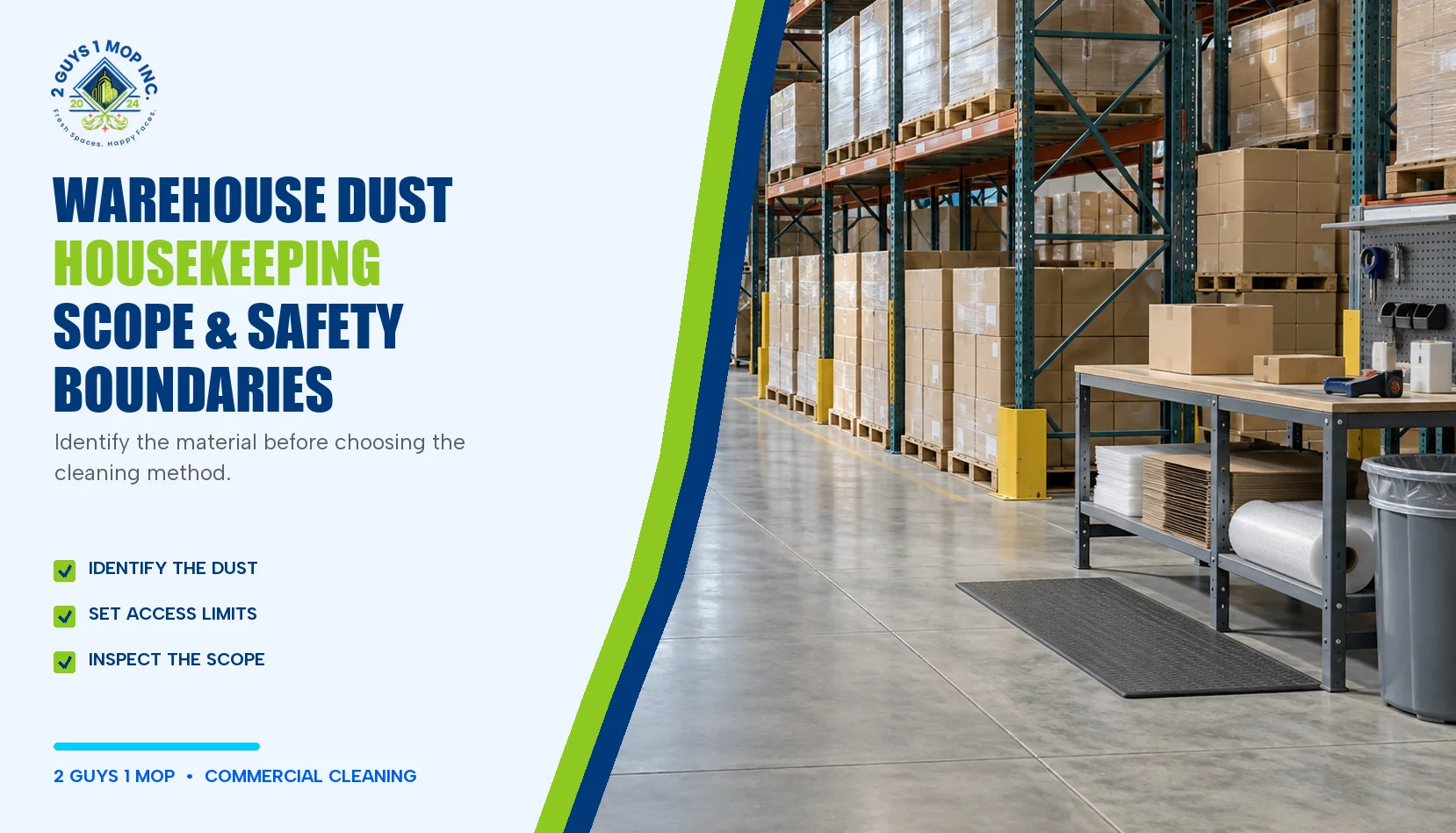
Warehouse dust needs a defined response, rather than an assumption that every deposit can be swept or vacuumed in the same way. Start by identifying the material and where it comes from. Unknown, hazardous or potentially combustible dust requires a facility-led safety assessment before a cleanup method is chosen.
This guide helps facility managers prepare the ordinary-housekeeping part of that discussion. It does not establish that a janitorial provider can assess hazardous exposure, manage combustible dust or service industrial machinery. For a wider zone-by-zone plan, use the industrial facility cleaning scope checklist.
Identify the dust before choosing a method
Describe the operation producing the deposit, the material being handled and any existing safety information. Appearance alone cannot establish whether a dust is hazardous. The CCOHS combustible-dust guide explains why dust-producing activities need assessment for that hazard. An ordinary cleaning quote is not a substitute for that assessment.
Ask the facility’s safety lead to identify restricted materials and areas, the approved method, any specialist equipment requirements and who can authorize the work. Do not add an unknown residue to a routine janitorial checklist simply because it is visible on a floor.
Map where ordinary buildup returns
- Receiving: note deposits near bay doors, pedestrian entrances and staging areas.
- Packing: record cardboard fibres, label backing and loose ordinary waste separately from process dust.
- Storage: identify accessible edges and ledges, and distinguish them from elevated or restricted surfaces.
- Walkways: check visible markings, loose debris and obstructions through the facility’s inspection process.
- Connected offices: note where tracked material appears at doorway transitions.
Record the location, observation time and activity since the last service. A deposit that returns after a delivery needs a different investigation from dust that appears while a zone is unused. These observations are examples for planning; they are not measurements of your facility.
Set access and responsibility boundaries
Decide who clears stock, moves pallets and releases each work zone. Keep machinery, electrical components, elevated work and hazardous-material handling outside the ordinary scope unless the facility has separately approved the method and qualified personnel. A cleaning team should not improvise around operating equipment.
The CCOHS housekeeping guide treats responsibility, maintenance and inspection as parts of a housekeeping program. Apply that separation to your own list: cleaning removes agreed ordinary soil; maintenance addresses damage; safety personnel define hazard controls.
Use task triggers instead of a universal calendar
Agree on inspection points around the activities that actually produce ordinary debris. Review accessible packing zones after a busy dispatch period, entrance conditions after tracked-in wet weather, and out-of-the-way surfaces when approved access becomes available. These are conditional examples, not daily, weekly or monthly requirements for every warehouse.
For floor work, record the finish, ordinary soil type, compatible products, access window and reopening requirements before choosing equipment. The warehouse floor planning guide develops that separate surface-care task.
Check the result and recurring exceptions
Choose observable acceptance checks: agreed loose debris removed, accessible edges addressed, waste handled as specified and excluded areas reported. Note inaccessible stock, damaged flooring or continuing dust generation without calling them cleaning failures automatically. A presentable aisle does not prove that airborne exposure or combustible-dust risks have been controlled.
If buildup returns repeatedly, have the facility manager review the source and operational controls as well as the cleaning scope. Adding another visit cannot, by itself, resolve an unidentified source.
Turn dust observations into a scoped action plan
Bring a location list, material information, photographs where permitted, access restrictions and recurring observations to the discussion. Confirm the safety assessment first where the material is unknown or hazardous. Then assign the ordinary tasks and the person who will inspect them.
For a routine commercial cleaning scope, describe the accessible zones and exclusions. Confirm capability and availability for the actual work rather than assuming hazardous-dust services are included.